
About Presidency University
Presidency University, Bengaluru, is a NAAC ‘A’ accredited institution known for its commitment to academic excellence and holistic student development. Established in 2013, the University offers programmes across computer science, engineering, management, law, design, media, science, commerce, liberal arts & sciences, and allied health sciences.
Recognized nationally and internationally, the University has received multiple accolades, including QS-I Gauge Gold, Times Engineering Institute Survey rankings, and ASSOCHAM’s Best University of the Year (South). The University emphasizes innovation, research, and experiential learning, preparing students for global careers with a foundation in discipline, integrity, and ethical standards.
About Presidency School of Law
Presidency School of Law provides contemporary legal education to nurture future leaders and professionals. Offering undergraduate, postgraduate, and doctoral programmes, the School specializes in areas including Intellectual Property Law, International Trade Law, Corporate Law, Criminal Law, and Constitutional Law.
With an emphasis on interdisciplinary learning, practical exposure, and social responsibility, the School equips students with the skills and knowledge to navigate complex legal landscapes. Recognitions include AAA+ rating by Careers360 and rankings among India’s top law schools.
About the Environmental Law and Climate Change Committee (ELCCC)
The ELCCC serves as a platform for students and faculty to address environmental challenges through a legal lens. Focusing on environmental protection, sustainable development, and climate crisis mitigation, the Committee fosters research, advocacy, and awareness. It encourages critical analysis of environmental laws, human rights intersections, and global climate policies, empowering students to contribute meaningfully to environmental law and policy.
About the Conference
he International Conference “IP in the Climate and Sustainability Agenda” brings together policymakers, academics, innovators, industry leaders, and civil society to examine the role of Intellectual Property (IP) in addressing climate change and promoting sustainability.
Climate change presents urgent global challenges, and achieving the UN Sustainable Development Goals requires innovative solutions. IP systems—including patents, trademarks, copyrights, trade secrets, and geographical indications—play a pivotal role in encouraging green innovation, technology transfer, and equitable access to sustainable technologies.
Key questions explored:
• How can IP promote green innovation while ensuring technology access in developing countries?
• What role can international IP regimes play in balancing proprietary rights with the global public interest?
• How can traditional knowledge and community-driven solutions be protected and promoted?
Conference Highlights:
• Keynote addresses from international and national experts
• Paper presentations and interactive sessions
• Policy dialogues and actionable recommendations
• Networking and collaboration opportunities
Conference Objectives
1. Examine IP’s role in fostering innovation for climate change mitigation and adaptation.
2. Facilitate dialogue between policymakers, innovators, academics, and civil society.
3. Identify legal and policy frameworks balancing proprietary rights with global public interest.
4. Encourage collaboration for technology transfer, capacity building, and inclusive innovation.
Guidelines for Contributors and Participants
• Hybrid mode; international participants can attend online
• National participants must present in person • Interdisciplinary and empirical research encouraged
• Maximum of two co-authors per paper (both the authors must register)
• Certificates will be given to Presenters and Attendees.
Themes and Sub Themes
Theme 1: Circular Economy and IPR
• Fashion and Sustainability
• Right to Repair
• Circular Economy: Global South Perspectives
• IP Strategies for Sustainable Innovations
Theme 2: IPR and Sustainable/Green Technology
• Branding, Trademarks & Eco-Labelling
• IP Rights and Technology Diffusion in the Global South
• Patent Pools & Climate Technology Commons
• Greenwashing and Trademarks
Theme 3: IP, Climate Justice, and Access
• Balancing IP Rights with Equitable Access to Green Technology
• Indigenous Knowledge and Ecological Innovations: Protection vs Biopiracy
• Gender, IP, and Access in Vulnerable Communities
• Intersections of Environmental Law, Human Rights Law, and IP Law
Theme 4: Digital and Data Governance for Climate Equity
• IP and Access to Environmental Data & Software Tools
• Open Data for Climate Resilience: Licensing and IP Issues
• Ethical Data Sharing Agreements for Climate-Vulnerable Communities
• Climate Data Colonialism: Transparency and Accountability
Target Audience
• Academics and researchers in law, environmental science, and social sciences
• Policymakers and government officials
• NGOs and civil society representatives
• Legal practitioners and judiciary members
• Students and young professionals in climate change, sustainable development, and IPR
Submission Guidelines for Abstract
Only selected abstracts will be permitted for presentation.
• Abstract: The abstract should summarize the paper’s contents in 250-300 words. The abstract should be accompanied by a cover page stating the following:
• Title of the Paper: The title of the paper, Name and Designation of the author/s, Affiliations, E-mail addresses, and Contact number/s.
• Keywords: The abstract is to be accompanied by a minimum of three keywords and a maximum of six keywords.
• Abstract Submission: Abstract submission is to be done by addressing an email to elcinternationalconference2026@gmail.com
Guidelines for Submission of Research Paper
Title: The contribution title should be followed by the name of the primary author first, followed by second co-author and their designations and email address. The title shall be font size 14 and bold.
Length: The manuscript should contain an abstract of 250-300 words with not more than six keywords. Both the abstract and keywords are mandatory. The manuscript should be of an average length of 4500-6000 words, typed in MS Word, with 1.5 line space, 12 Font size, Times New Roman font.
Figure, Tables, Images or Illustrations: Each table, figure or illustration shall have a caption. A reference citation may be added to the table source at the end of the caption, if necessary.
Proper citation should be given in the manuscript for Images/Figures and Tables reproduced from other sources.
All tables are cited in the text in sequential order. Do not write “the following table”. Figures shall be numbered and cited in the text in sequential order. Do not write “the following figure”.
The tables and figures in the text, if any, should be centred with proper titles and figures. Scattered images and tables are not accepted. A figure caption is always placed below the illustration. Short captions are to be centered, while long ones are justified.
References & Footnotes: American Psychological Association (APA) citation (fifth edition) format to be strictly adhered to.
Headings: Heading levels (i.e. Sub-topics) should be clearly identified and each level should be consistently formatted and/or numbered. Use the decimal system of numbering if your headings are numbered. Only two levels of headings should be numbered. Lower-level headings remain unnumbered; they are formatted as run-in headings. The contribution should contain no more than four levels of headings. The first level heading shall be 12-point font size and bold. The second level heading shall be 10-point font size and bold.
Technical terms and abbreviations: They should be defined the first time they appear in the text. Italics should be used for emphasized words or phrases in running text, but do not format entire paragraphs in italics. Bold formatting should only be used for run-in headings.
Correspondence: One author should be designated as Corresponding author and will be the principal contact for the editorial team for any publication related matters. Corresponding authors should get the consent from the co-authors for any matter related to publication.
Upon acceptance of the article, the copyright form should be submitted to the editorial office signed by all authors. If acceptable to all authors, the corresponding author ma sign on their behalf.
All correspondence should be addressed to elcinternationalconference2026@gmail.com
Publication Policy: All selected articles will be considered to be published in the form of an edited book. Depending on the quality of submission the conference intends to publish its proceedings with potential publishers.
Prize Money
Best Faculty Presenter
₹20,000
Best Student Presenter
₹15,000

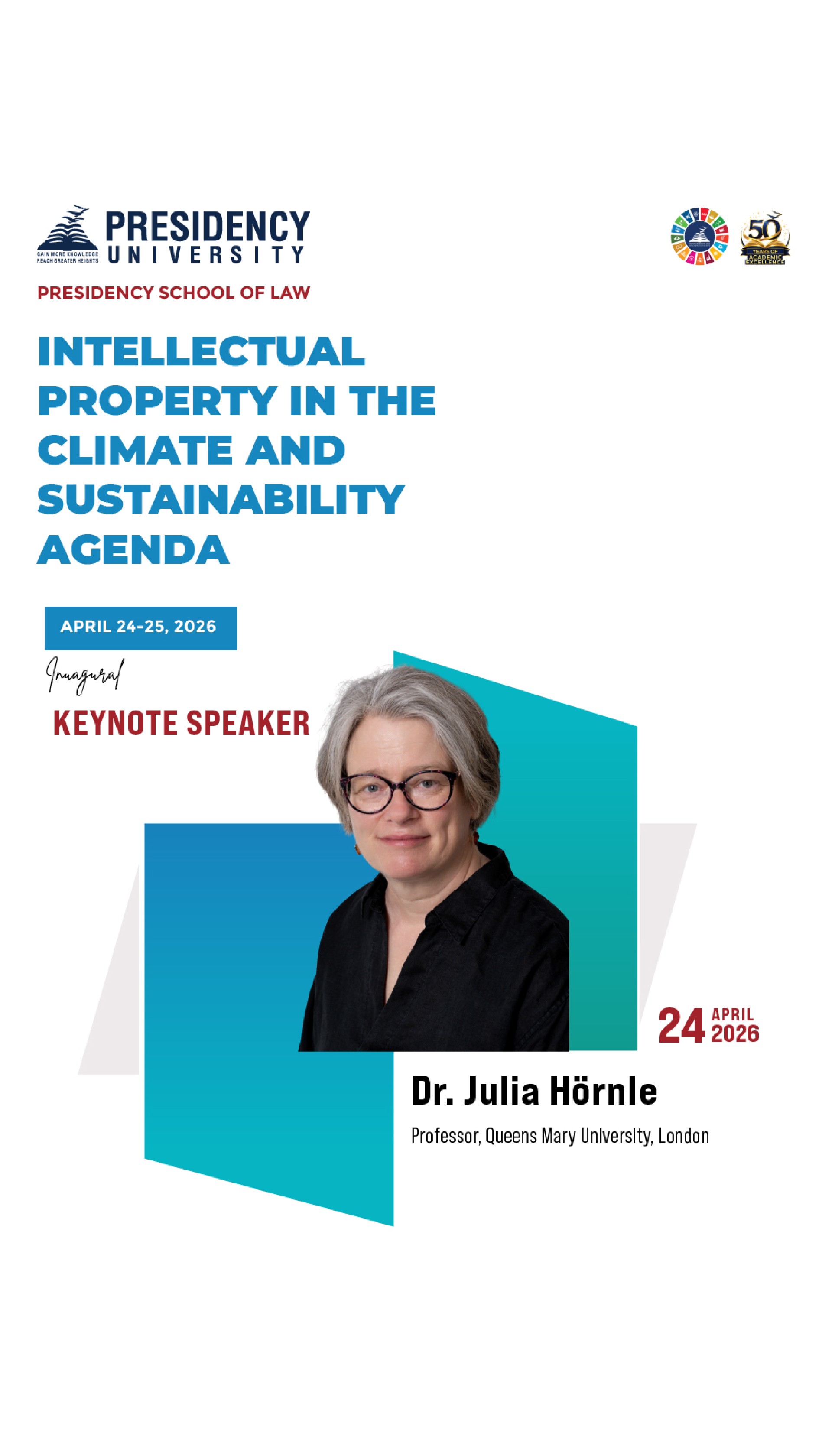
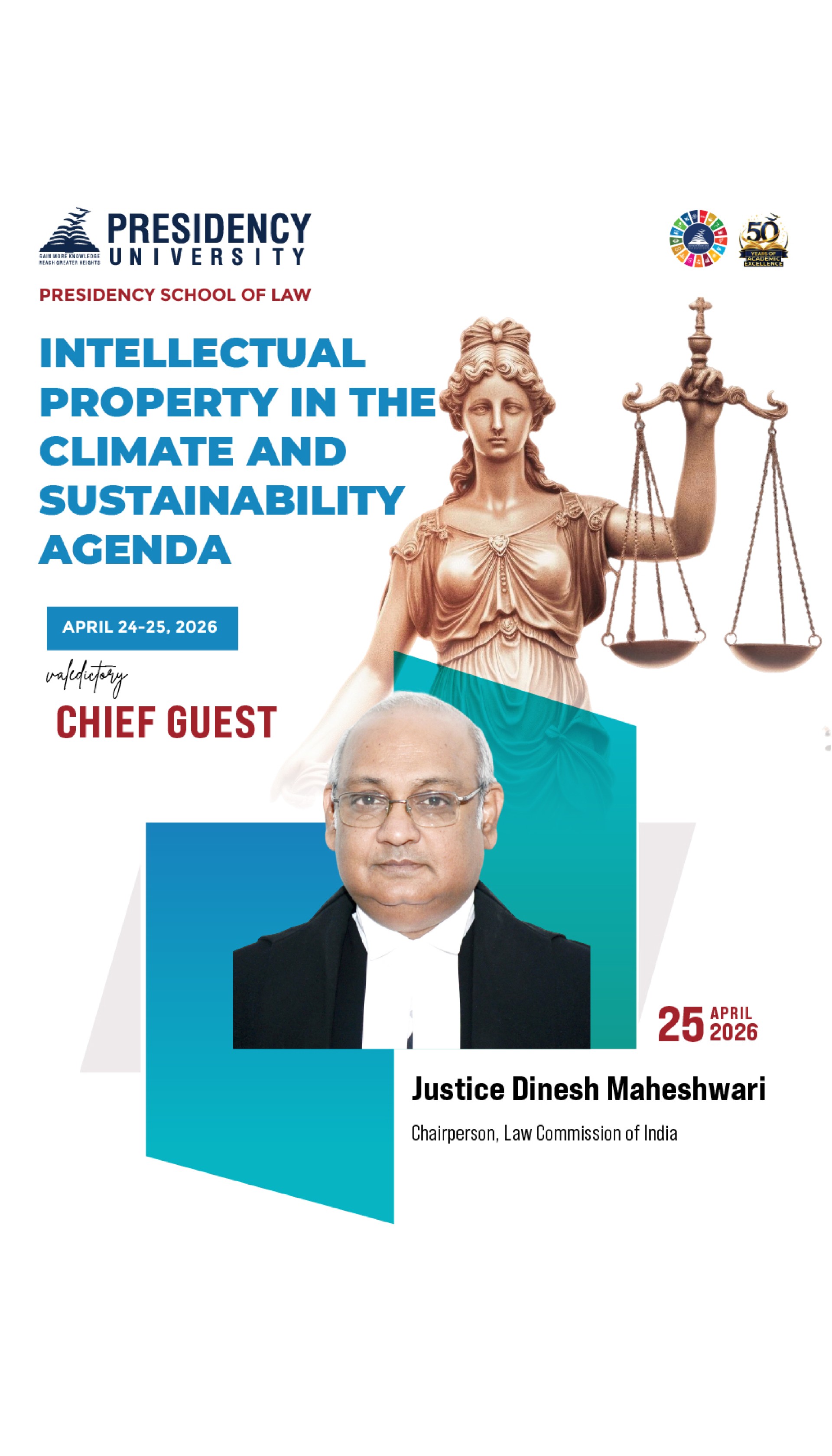
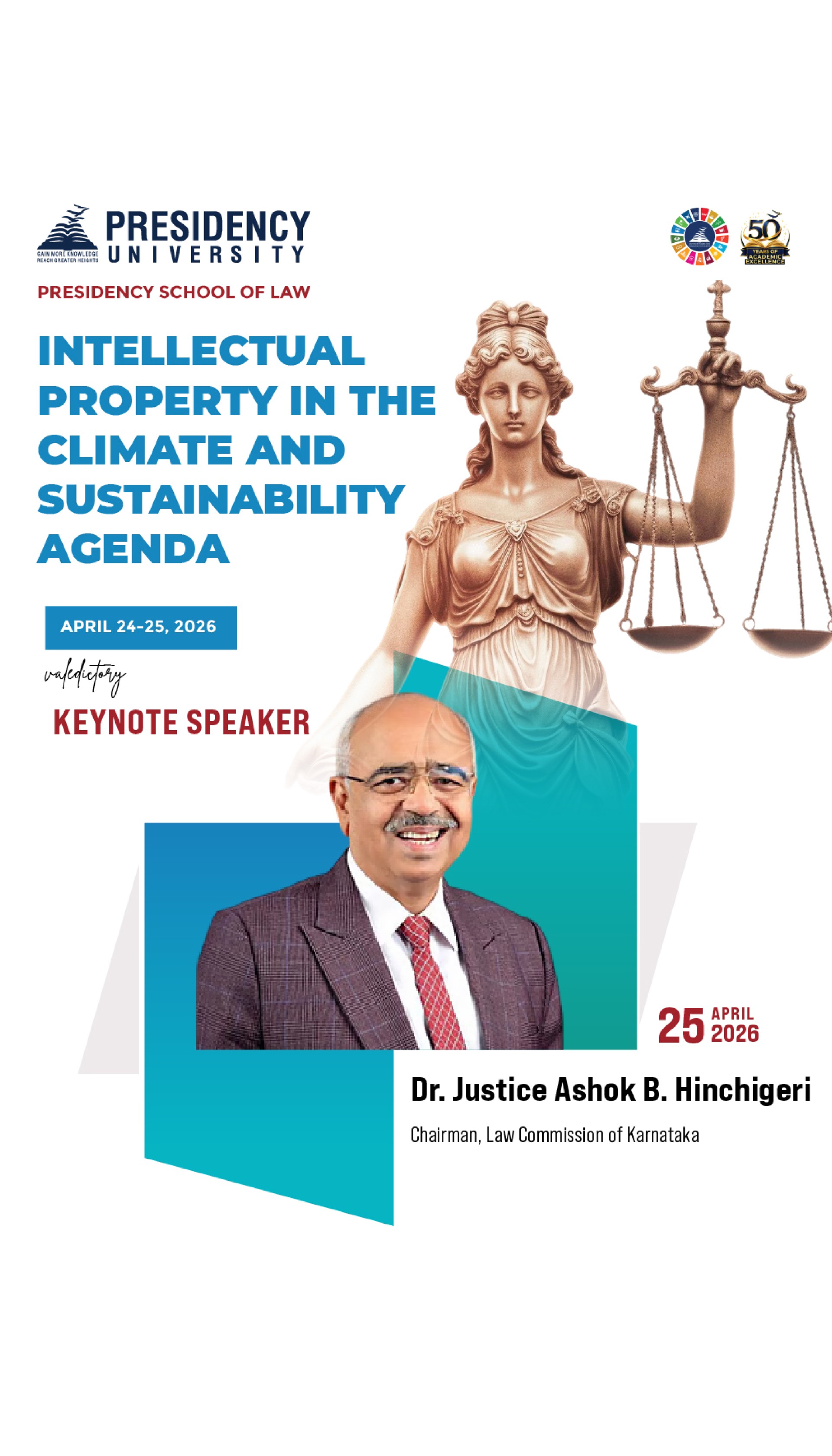
- Dr. Nissar Ahmed, Honourable Chancellor, Presidency University
- Dr. S. J. Thiruvengadam, Vice Chancellor In-Charge
- Dr. Vidya Shetty, Pro Vice Chancellor
- Dr. Sivaperumal S, Pro Vice Chancellor
- Dr. Sameena Noor Ahmad Panali, Registrar
- Prof. Dr. Saroj Sharma
Dean, Presidency School of Law (PSOL)
|
Abstract Submission: |
20 February 2026 |
|
Acceptance & Confirmation: |
03 March 2026 |
|
Final Paper Submission: |
03 April 2026 |
|
Final Acceptance Notification: |
Post peer review |
|
Category |
Participant Type |
Fee |
|---|---|---|
|
PRESENTERS |
International Academicians and Practitioners |
$50 |
|
International Students |
$45 |
|
|
National Academicians/Practitioners |
₹3500 |
|
|
National Students |
₹3000 |
|
|
Participants from Presidency |
₹1000 |
|
|
PARTICIPANTS |
International Participants |
$30 |
|
National Participants |
₹2000 |
|
|
Participants from Presidency |
₹500 |
All Payment are to be made as soon as the papers are accepted and there are no refunds.
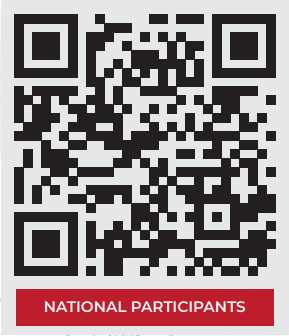
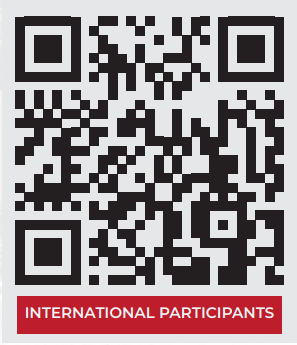
SCAN TO REGISTER

Contact Details
FACULTY COORDINATORS
MS. PALLAVI CHHABARIA
Asst.Professor PSOL
Presidency University – Bengaluru, India
Mobile: +91 9675743595
E-mail: icgta2026@presidencyuniversity.in
MS. RAZINA AHMED
Asst.Professor PSOL
Presidency University – Bengaluru, India
Mobile: +91 7636887376
DR. MANINDRA SINGH HANSPAL
Asst.Professor PSOL
Presidency University – Bengaluru, India
Mobile: +91 8249390625
MS. PALLAVI CHHABARIA
Asst.Professor PSOL
Presidency University – Bengaluru, India
Mobile: +91 9675743595
E-mail: icgta2026@presidencyuniversity.in
MS. RAZINA AHMED
Asst.Professor PSOL
Presidency University – Bengaluru, India
Mobile: +91 7636887376
DR. MANINDRA SINGH HANSPAL
Asst.Professor PSOL
Presidency University – Bengaluru, India
Mobile: +91 8249390625
For further information and registration:
Email: elcinternationalconference2026@gmail.com
Website: www.presidencyuniversity.in


 +91 9022092222
 admission@presidencyuniversity.in
 Rajanukunte, Yelahanka, Bengaluru, Karnataka, Pin: 560119, India
 +91 9022092222