
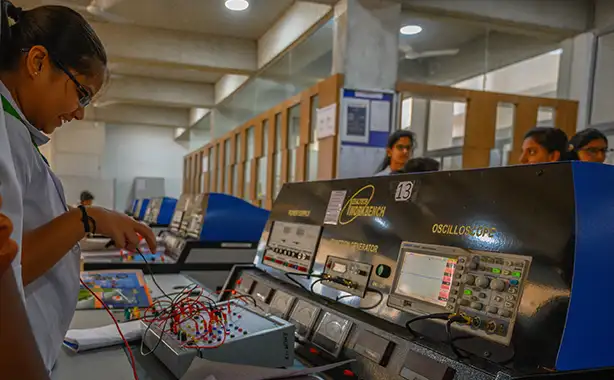
Signals and Systems Lab
The Signals and Systems Lab provides students with a strong practical foundation in the analysis and implementation of continuous-time and discrete-time signals and systems using MATLAB. Through experiments involving signal generation, transformation, convolution, correlation, Fourier analysis, Laplace and Z-transforms, and system response evaluation, students develop analytical, computational, and visualisation skills. The Lab bridges theoretical concepts with practical applications in communication systems, signal processing, control engineering, and modern electronic systems.
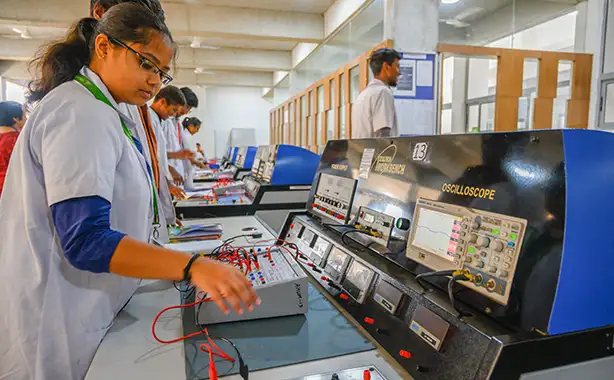
Digital Signal Processing Lab
The Digital Signal Processing Lab provides hands-on training in the analysis, design, and implementation of digital signal processing algorithms using MATLAB and DSP hardware platforms. Students perform experiments on sampling, convolution, DFT, FFT, spectral analysis, and digital filter design. The Lab covers FIR and IIR filter implementation using industry-relevant design techniques and introduces real-time signal processing using DSP processors. Through simulation and hardware implementation, students gain practical expertise in algorithm development, performance evaluation, and modern DSP applications.
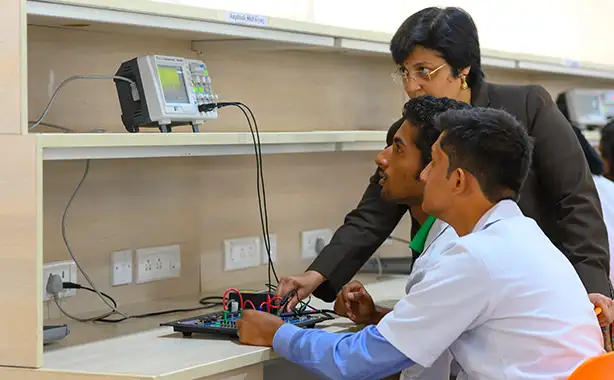
VLSI Design Lab
The VLSI Design Lab offers comprehensive practical exposure to contemporary VLSI design methodologies and semiconductor design workflows. Equipped with Cadence EDA tools, AMD Xilinx Vivado software, and FPGA development platforms, the Lab enables students to design, simulate, verify, and implement digital and mixed-signal circuits. Students work with CMOS devices, logic circuits, RTL design, synthesis, timing analysis, and FPGA prototyping using Verilog and VHDL. The Lab develops industry-relevant skills in integrated circuit design, verification, optimization, and hardware realization.
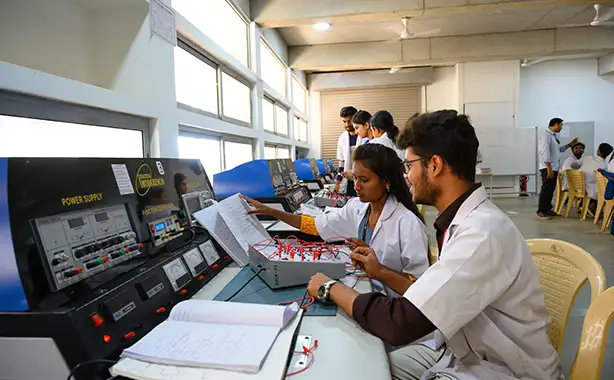
Analog Communication Lab
The Analog Communication Lab complements theoretical learning through experiments focused on the generation, analysis, and evaluation of analog communication systems. Students study amplitude, frequency, and phase modulation techniques using both hardware trainer kits and MATLAB/Simulink environments. The Lab emphasizes signal generation, modulation, demodulation, bandwidth analysis, and noise performance evaluation. Through structured experimentation, students develop strong analytical and problem-solving skills relevant to communication engineering and signal transmission systems.
Digital Communication Lab
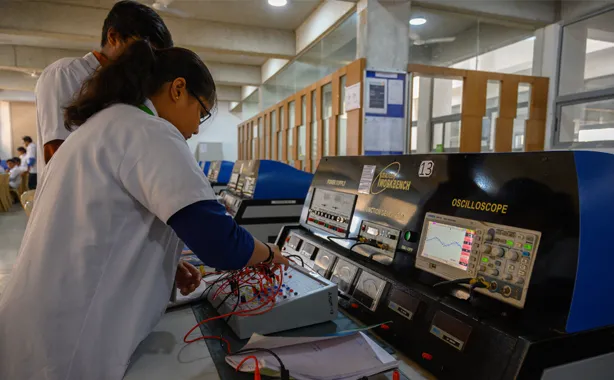
The Digital Communication Lab provides practical experience in the analysis, design, and evaluation of digital communication systems. Students investigate digital modulation techniques such as Amplitude Shift Keying (ASK), Frequency Shift Keying (FSK), and Phase Shift Keying (PSK), along with multiplexing methods, data formats, and system performance measures. Hardware-based experiments and MATLAB simulations enable students to validate theoretical concepts and understand modern communication technologies. The Lab strengthens analytical abilities, experimental proficiency, and communication-system design skills.
Embedded Systems Design using Microcontrollers Lab
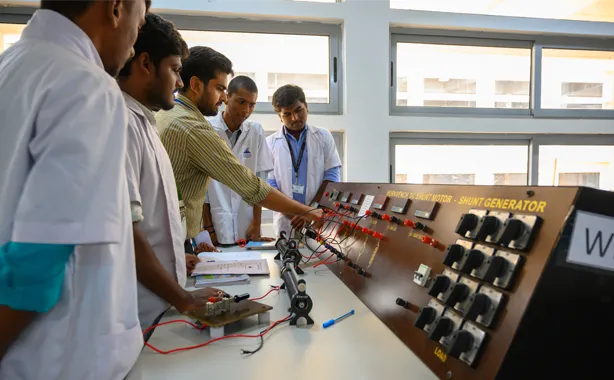
The Embedded Systems Design using Microcontrollers Lab provides practical training in ARM LPC2148 microcontroller programming and embedded-system development. Students gain experience in Assembly Language Programming, Embedded C, peripheral interfacing, and real-time hardware control using the Keil µVision development environment. Experiments include GPIO programming, timers, interrupts, serial communication, ADC, DAC, PWM generation, motor control, and display interfacing. The Lab equips students with the skills required to design, debug, and deploy embedded solutions for industrial and consumer applications.
Linear Integrated Circuits Lab
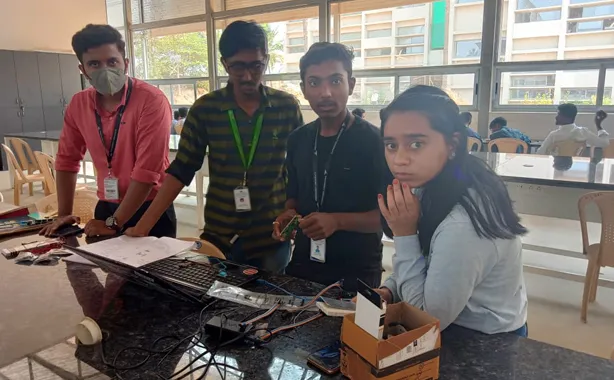
The Linear Integrated Circuits Lab provides practical exposure to the design, implementation, and testing of analog electronic circuits. Students perform experiments involving operational amplifiers, rectifiers, oscillators, voltage regulators, timers, and phase-locked loops using industry-standard Lab equipment. The Lab develops competency in circuit analysis, waveform interpretation, component selection, measurement techniques, and troubleshooting. By correlating theoretical principles with experimental observations, students gain a deeper understanding of analog electronics and integrated-circuit applications.
Digital Electronics Lab
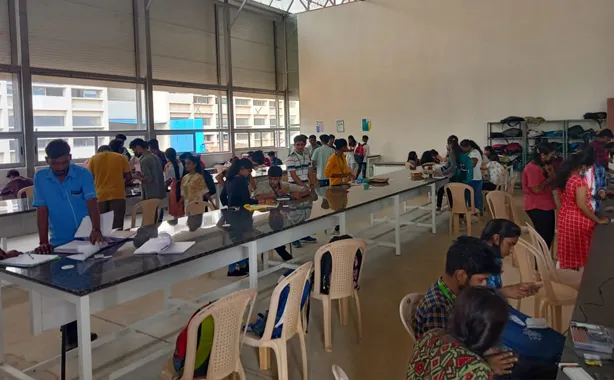
The Digital Electronics Lab introduces students to the fundamentals of digital logic design through hands-on experimentation using trainer kits, integrated circuits, and HDL-based tools. Students verify logic-gate operation, implement combinational and sequential circuits, and analyze the behavior of counters, flip-flops, and shift registers. Exposure to hardware description languages and simulation tools connects traditional circuit implementation with modern digital design methodologies. The Lab develops analytical thinking, design capability, and a strong foundation for advanced studies in electronics and embedded systems.
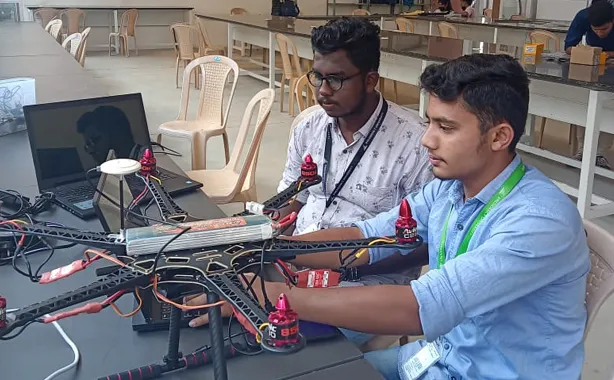
Microwave Antenna and Wave Propagation Lab
The Microwave, Antenna, and Wave Propagation Lab provides practical training in microwave engineering, antenna systems, and RF measurements. Students work with waveguides, microwave sources, directional couplers, attenuators, circulators, power meters, and horn antennas to perform experiments related to VSWR, impedance matching, frequency measurement, radiation-pattern analysis, and gain determination. The Lab also incorporates CST Studio Suite for electromagnetic simulation and antenna design. This combination of measurement and simulation prepares students for careers in wireless communication, radar, satellite communication, and RF engineering.
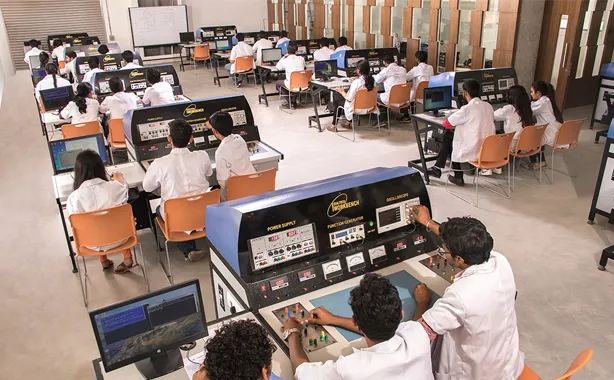
Microcontroller Applications Lab
The Microcontroller Applications Lab provides hands-on training in 8051 microcontroller programming, hardware interfacing, and embedded-system implementation. Students develop applications using Assembly Language Programming and Embedded C while interfacing peripherals such as ADCs, DACs, LCDs, sensors, and motors. Through programming, simulation, and hardware verification, students learn display control, waveform generation, automation techniques, and real-time control. The Lab strengthens practical knowledge of microcontroller-based system design and embedded applications.


 +91 9022092222
 admission@presidencyuniversity.in
 Rajanukunte, Yelahanka, Bengaluru, Karnataka, Pin: 560119, India
 +91 9022092222