Not a Doctor, Still Saving Lives: The Healthcare Careers Biology Students Overlook
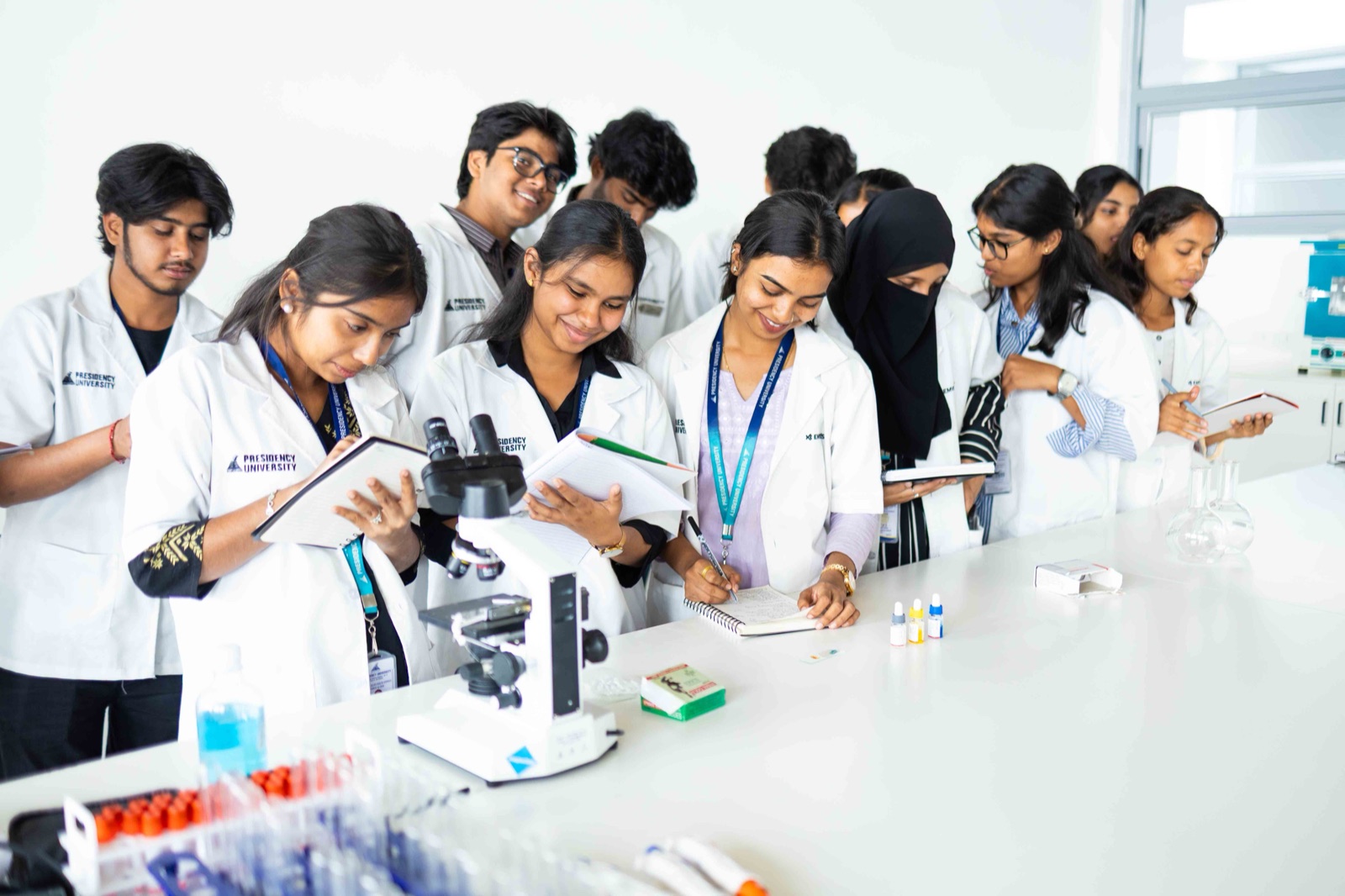
Presidency School of Allied and Healthcare Professions
Ask a room full of Class 12 biology students what they want to become and you'll hear "doctor" more times than you can count. Ask them why, and the answers change. "I want to help people." "I like how the body works." "I want to see the difference I make."
None of those reasons point only towards MBBS.
Walk through any hospital and look at who is doing the hands-on work. Someone is running the ECG. Someone is getting the operation theatre ready before the surgeon walks in. Someone is taking the scan, and weeks later, someone is helping a patient take their first shaky steps again. Most of them aren't doctors. They're allied health professionals.
Why choose allied health sciences? You meet patients early
Most allied health degrees run for about four years, and the clinical work doesn't wait until the end. The Bachelor of Physiotherapy at Presidency University promises clinical training from the early semesters, in multi-specialty hospitals and diagnostic labs. Cardiac Care Technology and Medical Radiology and Imaging Technology both include a year of supervised clinical internship, and Occupational Therapy adds a compulsory one-year rotatory internship after four years of study.
If you learn best by doing, that makes a big difference.
NEET isn't always the way in
Parents are often surprised by this. The Cardiac Care Technology and the Anaesthesia and Operation Theatre Technology pages both say you don't need an entrance exam, and that admission is generally based on Class 12 science marks. Occupational Therapy is different: you need to have appeared for NEET. So check each course, but one exam doesn't decide whether you get to work in healthcare.
You'll work right next to new technology
In July 2025, researchers at Columbia University described an AI tool called EchoNext in the journal Nature. It learned to spot structural heart disease from an ordinary ECG. In testing, it caught 77% of cases, while cardiologists reading the same ECGs caught 64%.
In December 2024, the US FDA authorised the first spinal cord stimulator that works without surgery. It's used during therapy sessions for people with long-term spinal cord injuries, and in its trial, 90% of participants gained strength or function in their hands and arms. In 2025, a Mumbai hospital installed South Asia's first photon-counting CT scanner.
None of these machines works on its own. A cardiac technologist records that ECG, a physiotherapist plans those therapy sessions, and an imaging technologist runs that scanner.
The profession now has national standards
For years, allied health in India didn't have the national framework that medicine and nursing had. That's changing.
In April 2025, the Union Health Ministry and the National Commission for Allied and Healthcare Professions (NCAHP) released national curricula for ten professions, including physiotherapy, medical imaging, and anaesthesia and OT technology. At the end of August 2026, the NCAHP notified rules that, for the first time, set up state and national registers covering 57 professions. Registration will need renewing every five years, with 15 hours of continuing professional development each year.
In plain terms, the degree you earn now carries more weight than it used to.
There's a course for almost every personality
Allied health isn't one job. It's a family of them, and Presidency's School of Allied and Healthcare Professions offers five.
Fascinated by the heart? Cardiac Care Technology takes you from ECG and echocardiography to cardiac catheterisation and perfusion technology. Sporty, or curious about how bodies move? Physiotherapy covers biomechanics along with sports, neurological and cardiothoracic physiotherapy. If you want to help people get their everyday lives back after illness or injury, look at Occupational Therapy. If you like physics and machines, Medical Radiology and Imaging Technology covers X-ray, CT, MRI, ultrasound and an introduction to nuclear medicine. And if you're the one who stays calm when everyone else panics, Anaesthesia and Operation Theatre Technology could suit you.
What about salaries?
Families always ask, and they should. Three of the programme pages give typical starting salaries: around ₹3 to ₹6 lakh a year for Cardiac Care Technology, and around ₹2.5 to ₹4.5 lakh a year for Physiotherapy and for Anaesthesia and OT Technology. The OT technology page adds that this can grow to ₹5 to ₹8 lakh or more with experience. Actual pay depends on your skills, your city and your employer.
Who it isn't for
The work is hands-on and can be physically tiring, and you'll spend your days around people who are unwell, scared or in pain. If hospitals make you uneasy, or you want a quiet desk job, you'll probably be happier elsewhere.
If none of that puts you off, take a proper look. Each programme page lists its eligibility, duration and course structure, so comparing them is easy.
Not everyone who saves the day in a hospital wears a white coat.


 +91 9022092222
 admission@presidencyuniversity.in
 Rajanukunte, Yelahanka, Bengaluru, Karnataka, Pin: 560119, India

 +91 9022092222